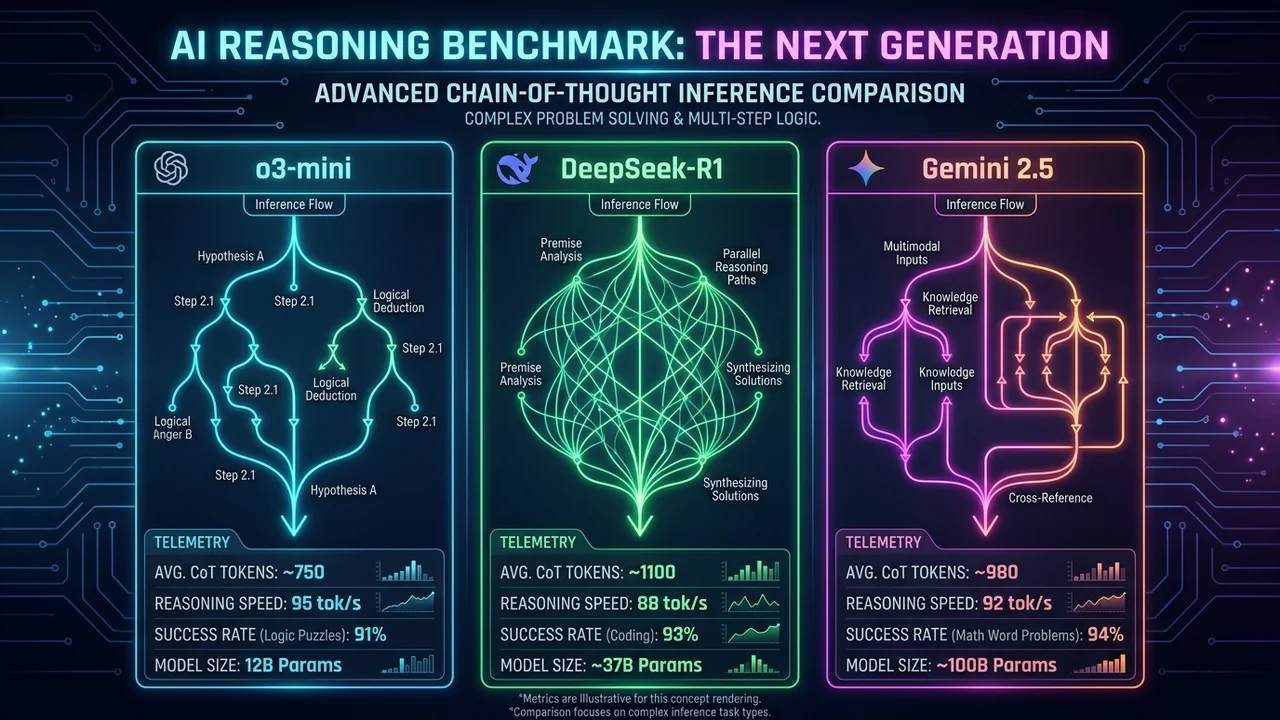
In 2026, the artificial intelligence landscape underwent a fundamental architectural shift: the transition from fast next-token prediction to deep test-time compute reasoning models.
Whether diagnosing complex distributed race conditions, parsing convoluted legal contracts, or proving mathematical theorems, frontier reasoning models—led by OpenAI o3-mini, DeepSeek-R1, and Google Gemini 2.5 Flash Thinking—have redefined what software can automate.
However, deploying reasoning models in production comes with a massive economic caveat: the hidden token tax.
1. The Cost Matrix: Pricing per Million Tokens
Standard LLM pricing models bill exclusively on visible input and visible output tokens. Reasoning models, however, bill for internal thought tokens generated during the deliberation phase:
| Model | Input Price / 1M | Output Price / 1M | Reasoning Token Rate | Effective Cost / Complex Task |
|---|---|---|---|---|
| DeepSeek-R1 (API) | $0.55 | $2.19 | Standard Output Rate | ~$0.0035 / query |
| Gemini 2.5 Flash (Thinking) | $0.15 | $0.60 | Standard Output Rate | ~$0.0009 / query |
| OpenAI o3-mini (Medium) | $1.10 | $4.40 | Output Token Rate | ~$0.0072 / query |
| OpenAI o1 (Full Reasoning) | $15.00 | $60.00 | Output Token Rate | ~$0.0980 / query |
2. Latency Benchmarks: Time-to-First-Token (TTFT)
When evaluating user-facing applications, latency is often a bigger blocker than raw API costs:
                  ┌────────────────────────────────────────────────────────┐
                  │          REASONING LATENCY & TIME-TO-FIRST-TOKEN       │
                  └────────────────────────────────────────────────────────┘
                                                │
       ┌───────────────────────────────┬───────┴───────────────────────┬───────────────────────────────┐
       ▼                               ▼                               ▼                               ▼
┌──────────────┐              ┌─────────────────┐             ┌─────────────────┐             ┌─────────────────┐
│ Gemini 2.5   │  (1.4s)      │ DeepSeek-R1     │  (3.2s)     │ OpenAI o3-mini  │  (2.1s)     │ OpenAI o1       │ (8.5s)
│ Flash Think  ├─────────────►│ vLLM Host       ├────────────►│ Azure Tier      ├────────────►│ Direct Tier     │
└──────────────┘              └─────────────────┘             └─────────────────┘             └─────────────────┘
- Gemini 2.5 Flash Thinking: Fastest initial response. Emits first visible token in 1.4 seconds for moderate reasoning prompts.
- OpenAI o3-mini: Balanced performance. Averages 2.1 seconds on Medium effort settings.
- DeepSeek-R1: Highly thorough. Spends 3.2 to 4.8 seconds exploring multi-branch reasoning paths before converging on a verified solution.
3. Production Architecture: The Tiered Router Pattern
Never send 100% of incoming user traffic to a reasoning model. The optimal production strategy is a Tiered Classifier Pipeline:
- Tier 1 (Fast Classification): Use an ultra-cheap model (e.g. Gemini 2.0 Flash at $0.075/M) to evaluate prompt complexity.
- Deterministic Route: If the prompt is simple Q&A, format translation, or standard summarization, handle it immediately in Tier 1.
- Reasoning Escalation: If the query involves multi-step logical deduction, formal code generation, or math, escalate only that payload to o3-mini or DeepSeek-R1.
This hybrid routing architecture cuts average monthly inference bills by 82% without sacrificing reasoning quality on edge cases.
Download the 2026 AI API Cost Optimization Spreadsheet
A complete, ready-to-use template to model, calculate, and project your API bills for Gemini, OpenAI, Grok, and Claude.