Autonomous AI agents that fail 15% of the time are fine for Twitter demos. In production enterprise software, an agent with an 85% success rate is completely unusable.
When autonomous agents interact with payment gateways, customer database records, and critical cloud infrastructure, non-deterministic behavior is a fatal defect.
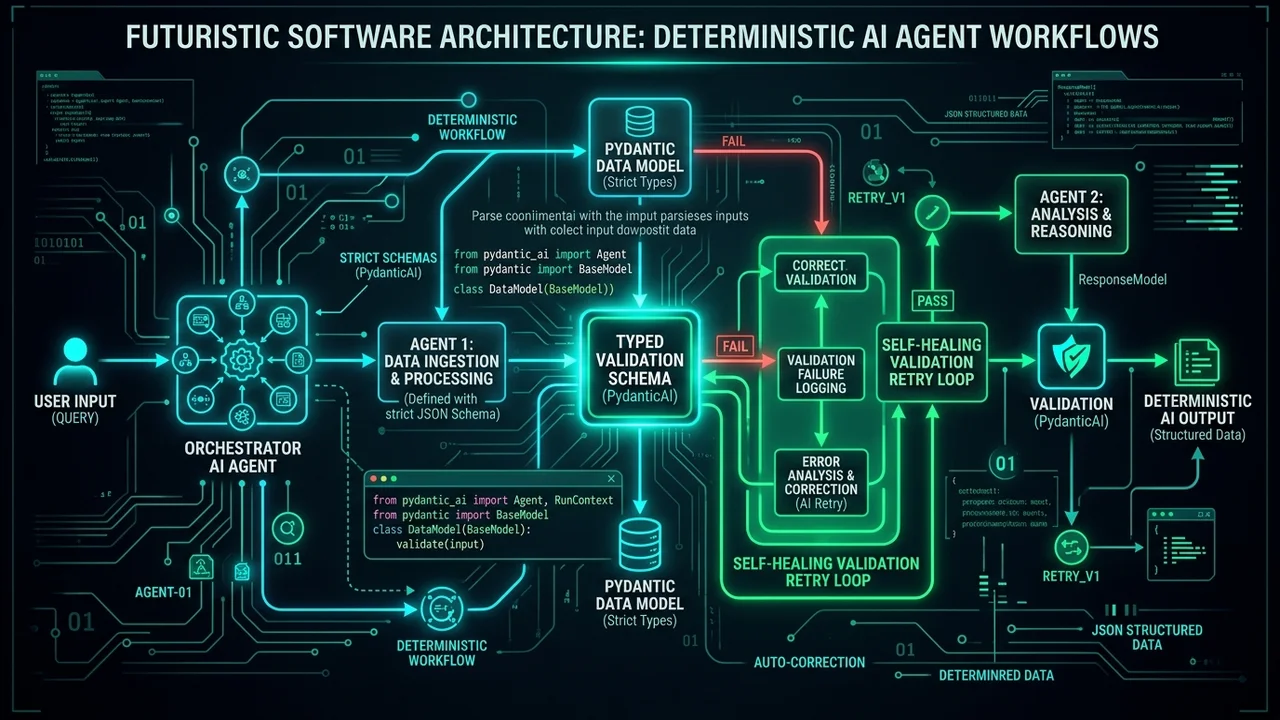
Here is the architectural pattern for building zero-failure deterministic agentic workflows using Python and PydanticAI.
1. The Core Flaw: Probabilistic Text vs. Deterministic Systems
Traditional software engineering is built on deterministic contracts: functions take typed inputs and guarantee typed outputs.
LLMs, conversely, are probabilistic token generators. When developers attempt to glue probabilistic text into deterministic relational databases using regex or loose JSON parsing, edge cases inevitably trigger production crashes.
from pydantic import BaseModel, Field
from pydantic_ai import Agent, RunContext
from dataclasses import dataclass

# 1. Define Invariant Domain Models
class RefundApproval(BaseModel):
    transaction_id: str = Field(..., regex=r"^txn_[a-zA-Z0-9]{12}$")
    amount_cents: int = Field(..., gt=0, le=50000)
    audit_reason: str = Field(..., min_length=15)
    fraud_risk_score: float = Field(..., ge=0.0, le=1.0)
By enforcing strict regular expressions, bounds checks, and length constraints, invalid data is caught at the compiler and schema level before it ever touches application code.
2. Dynamic Self-Correction via Validation Feedback Loops
The fundamental superpower of PydanticAI is type-safe validation retry loops.
When an LLM returns a payload with missing parameters or an invalid risk score, PydanticAI intercepts the validation failure, serializes the exact error trace into a targeted correction prompt, and forces the model to correct its mistake within the same context session:
[User Request] ──► [LLM Output] ──► [Pydantic Validator]
                          ▲                     │
                          │                     ▼
                   [Error Prompt] ◄──── [Validation Fails]
                                                │
                                                ▼ (Passes)
                                     [Execute Safe DB Mutation]
3. Dependency Injection Over Global State
In production architectures, agents should never access global database handles. Use PydanticAI’s typed RunContext to inject dependencies:
@dataclass
class AgentDependencies:
    db_session: DatabaseSession
    fraud_engine_client: FraudEngine
    current_user_id: str

agent = Agent(
    "gemini-2.0-flash",
    deps_type=AgentDependencies,
    result_type=RefundApproval,
    system_prompt="You are a senior compliance and refund review agent..."
)
This guarantees testability: in unit tests, simply pass mocked dependencies, verifying agent behavior without mutating production databases.
Get Weekly AI Architect Cost & Strategy Updates
Join 14,000+ developers receiving weekly, data-driven cost-reduction blueprints and production-ready agent guidelines.