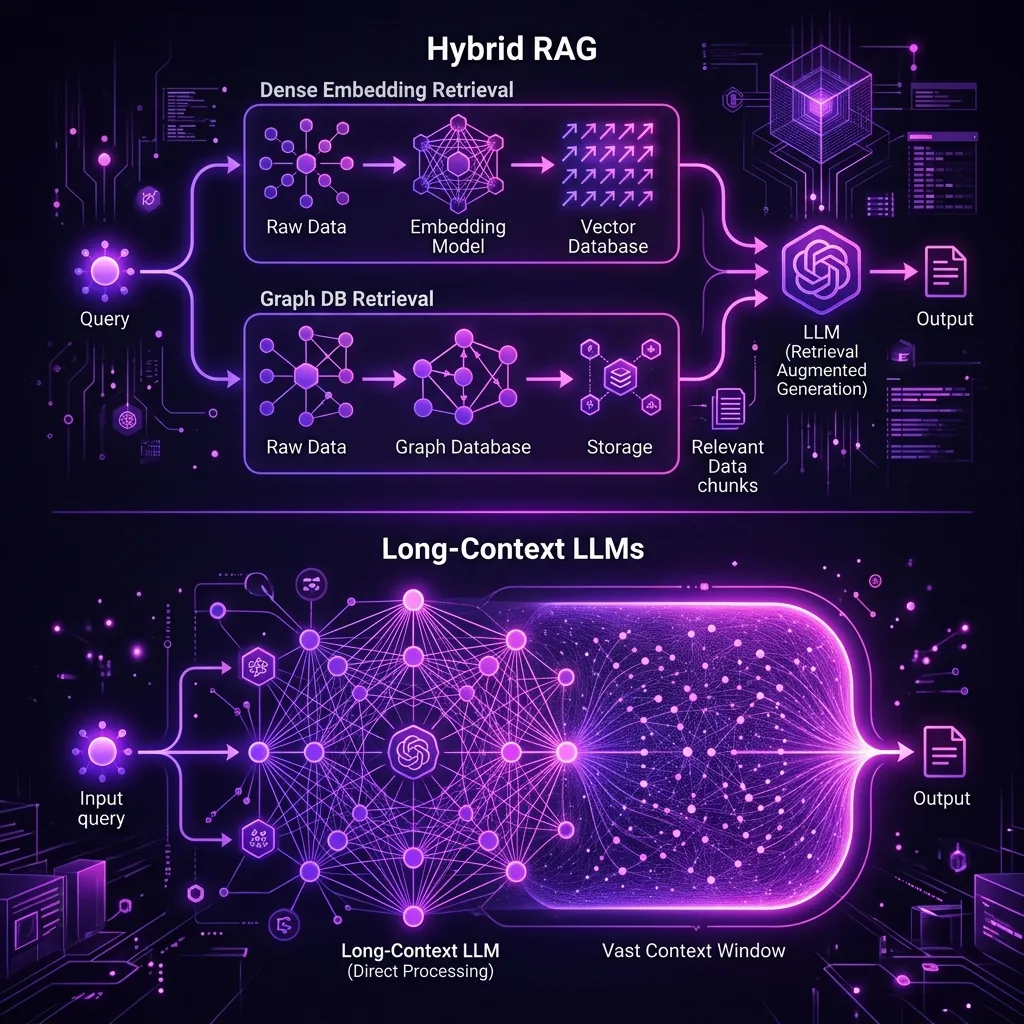
With the arrival of Google’s Gemini 3.1 Pro and xAI’s Grok 4.20 offering context windows of 1 to 2 million tokens, a common narrative has emerged in the developer community: "RAG (Retrieval-Augmented Generation) is dead. Why bother indexing documents when you can dump your entire corpus directly into the model’s context?"
While this “brute force context” approach is tempting for basic prototyping, it falls apart under the realities of production engineering. The truth is that RAG is not dead; it has evolved. In the era of massive context windows, RAG has transitioned from a simple tool for finding data to an essential architecture for filtering, structuring, and optimizing information density.
In this guide, we will break down the structural limitations of long-context models, analyze the math behind context costs, and map out a modern Hybrid RAG + Graph RAG pipeline complete with production-grade Python code.
The Long-Context Fallacy: Attention Dilution and Financial Reality
Before building an architecture that dumps 1,000 PDFs directly into a Gemini or Grok API, we must analyze the two critical constraints: attention mechanics and operating costs.
1. Attention Dilution (Retrieval-in-a-Haystack)
Most developers are familiar with the “Needle in a Haystack” (NIAH) test, where a model successfully retrieves a single hidden fact from a massive block of text. While Gemini 3.1 Pro passes the NIAH test with near-perfect scores up to 1 million tokens, actual production queries are rarely simple lookups.
When you ask a model to synthesize information, identify trends, or perform complex reasoning over multiple disjointed sources scattered throughout a 1-million-token context, attention dilution occurs. The model’s transformer layers struggle to allocate sufficient attention weights to thousands of relevant tokens at once, leading to missed details, logic errors, and hallucinations.
2. The Financial and Latency Equation
Let’s run the actual economics as of May 2026. Querying a large-context model with 1 million tokens is expensive and introduces substantial latency:
| Metric | Google Gemini 3.1 Pro (1M Context) | OpenAI GPT-4.1 (1M Context) | xAI Grok 4.20 (2M Context) |
|---|---|---|---|
| Cost per Query (Uncached) | $2.00 | $2.00 | $4.00 |
| Cost per Query (Cached) | $0.20 | $0.50 | $0.40 |
| Time to First Token (TTFT) | ~6.5 seconds | ~7.2 seconds | ~9.8 seconds |
If your system runs 10,000 multi-turn queries per day:
- Without RAG (1M tokens per query): $20,000 / day in API costs.
- With Prompt Caching (1M tokens cached prefix): $2,000 / day in API costs, but with a persistent 6+ second latency lag.
- With Hybrid RAG (filtering context to a highly dense 10,000 tokens): $0.02 / query = $200 / day, with a TTFT of under 800ms.
RAG remains the ultimate architectural pattern for optimizing cost, speed, and accuracy.
The Hybrid RAG Architecture: Dense, Sparse, and Graph
To build a retrieval system that beats massive context windows, we must combine three distinct retrieval layers into a unified pipeline:
                  ┌────────────── User Query ──────────────┐
                  │                                        │
                  ▼                                        ▼
      ┌───────────────────────┐                ┌───────────────────────┐
      │     Lexical (Sparse)  │                │    Semantic (Dense)   │
      │         BM25 Search   │                │     ColBERT / BGE-M3  │
      └───────────┬───────────┘                └───────────┬───────────┘
                  │                                        │
                  ▼                                        ▼
         Ranked Sparse Chunks                     Ranked Dense Chunks
                  │                                        │
                  └───────────────────┬────────────────────┘
                                      │
                                      ▼
                          ┌───────────────────────┐
                          │   Cross-Encoder       │ <── Graph RAG Entity Links
                          │   Re-ranking Model    │
                          └───────────┬───────────┘
                                      │
                                      ▼
                          Top Dense Context Chunks
                         (Fed into LLM Cache Window)
1. Lexical (Sparse) Retrieval: BM25
- Purpose: Matches exact strings, serial numbers, variable names, and specialized error codes.
- Why it matters: Neural networks are surprisingly poor at matching specific alphanumerical terms (e.g.,
ERR_CODE_9874X). BM25 ensures these are never missed.
2. Semantic (Dense) Retrieval: ColBERT / BGE-M3
- Purpose: Captures the conceptual meaning and intent of the query, even if the phrasing is completely different.
- Why it matters: Unlike standard single-vector embeddings, late-interaction models like ColBERT store separate token-level embeddings, allowing for ultra-fine-grained alignment between queries and documents.
3. Graph RAG: Relational Linkage
- Purpose: Connects facts across documents using an Entity-Relation graph.
- Why it matters: If Document A says “Alice is the CTO of X-Corp” and Document B says “X-Corp just released a new security protocol”, a standard vector search will fail to connect Alice to the security protocol. Graph RAG links these entities together, feeding the LLM the exact structural pathway.
Python Implementation: Designing the Hybrid Retriever
Below is a complete, production-ready Python pipeline that merges semantic vector search, BM25, and a Cross-Encoder Re-ranker (such as Cohere Rerank v4 or BGE-Reranker-Large) to reduce a million-token raw dataset down to a highly optimized, high-density context.
import numpy as np
from rank_bm25 import BM25Okapi
from sentence_transformers import SentenceTransformer, CrossEncoder

class AdvancedHybridRetriever:
    def __init__(self, embedding_model_name: str = "BAAI/bge-m3", reranker_name: str = "BAAI/bge-reranker-large"):
        # Load embedding model and cross-encoder reranker
        self.encoder = SentenceTransformer(embedding_model_name)
        self.reranker = CrossEncoder(reranker_name)
        self.corpus: list[str] = []
        self.tokenized_corpus: list[list[str]] = []
        self.bm25: BM25Okapi = None
        self.dense_embeddings: np.ndarray = None

    def fit(self, documents: list[str]):
        """Indexes the document collection for both dense and sparse retrieval."""
        self.corpus = documents
        self.tokenized_corpus = [doc.lower().split(" ") for doc in documents]
        self.bm25 = BM25Okapi(self.tokenized_corpus)

        # Precompute dense embeddings
        print("Generating dense vector embeddings for corpus...")
        self.dense_embeddings = self.encoder.encode(documents, convert_to_numpy=True)

    def retrieve(self, query: str, top_k: int = 20, rerank_k: int = 5) -> list[tuple[str, float]]:
        """Executes lexical + semantic hybrid search, followed by cross-encoder re-ranking."""
        if not self.corpus:
            return []

        # 1. Lexical (Sparse) Search via BM25
        tokenized_query = query.lower().split(" ")
        bm25_scores = self.bm25.get_scores(tokenized_query)

        # Normalize BM25 scores between 0 and 1
        bm25_scores = (bm25_scores - np.min(bm25_scores)) / (np.max(bm25_scores) - np.min(bm25_scores) + 1e-9)

        # 2. Semantic (Dense) Search via Vector Embeddings
        query_embedding = self.encoder.encode(query, convert_to_numpy=True)
        # Cosine similarity calculation
        norms = np.linalg.norm(self.dense_embeddings, axis=1) * np.linalg.norm(query_embedding)
        dense_scores = np.dot(self.dense_embeddings, query_embedding) / (norms + 1e-9)

        # 3. Reciprocal Rank Fusion (RRF) / Linear Weighted Fusion
        # We use a 50/50 balance between dense and sparse
        hybrid_scores = 0.5 * bm25_scores + 0.5 * dense_scores

        # Fetch the top_k candidates from the hybrid pool
        candidate_indices = np.argsort(hybrid_scores)[::-1][:top_k]
        candidates = [self.corpus[idx] for idx in candidate_indices]

        # 4. Cross-Encoder Re-ranking
        # The cross-encoder analyzes full sentence-level interactions for absolute precision
        pairs = [[query, candidate] for candidate in candidates]
        rerank_scores = self.reranker.predict(pairs)

        # Sort candidates based on the reranker's output
        sorted_indices = np.argsort(rerank_scores)[::-1]

        results = []
        for rank in range(min(rerank_k, len(sorted_indices))):
            idx = sorted_indices[rank]
            results.append((candidates[idx], float(rerank_scores[idx])))

        return results

# Example Usage
# retriever = AdvancedHybridRetriever()
# retriever.fit([
# "Enterprise policy states that all JWT tokens must expire within 15 minutes.",
# "To configure the database cluster, update the pool_size variable in db.yaml.",
# "Our network architecture utilizes hybrid sparse-dense routing tables.",
# "Contact the DevOps channel for issues regarding AWS IAM permission mismatches."
# ])
#
# top_hits = retriever.retrieve("How long are JWT tokens valid for?", top_k=3, rerank_k=2)
# for doc, score in top_hits:
# print(f"[{score:.4f}] {doc}")
The Verdict: When to Use RAG vs. Brute-Force Long Context
Long context and RAG are not mutually exclusive. In fact, they are highly synergistic. The most sophisticated AI architectures in production use them together:
- Use Brute-Force Long Context (100K+ tokens) when:
- You are doing exploratory analysis on a single, coherent codebase or book.
- Latency is not a priority (e.g., offline processing, batch jobs, background code generation).
-
You are executing rare, non-repetitive analytical tasks.
- Use Hybrid RAG (filtering down to <10K high-density tokens) when:
- You need low-latency responses (<1 second) in an interactive UI.
- You are scaling the application to millions of users and need to keep API costs minimized.
- You are searching across an ever-expanding, vast enterprise data ecosystem.
- You need to guarantee exact key matching (e.g., database IDs, hardware part numbers) alongside semantic intent.
By placing a robust, hybrid retrieval layer in front of your large-context models, you get the best of both worlds: the extreme reasoning ability of flagship models like Gemini 3.1 Pro, operating at the lightning speed and rock-bottom costs of small-context executions.
Are you building next-gen search engines? What are your experiences with transformer attention drift in million-token windows? Let’s talk in the comments below!
Get Weekly AI Architect Cost & Strategy Updates
Join 14,000+ developers receiving weekly, data-driven cost-reduction blueprints and production-ready agent guidelines.