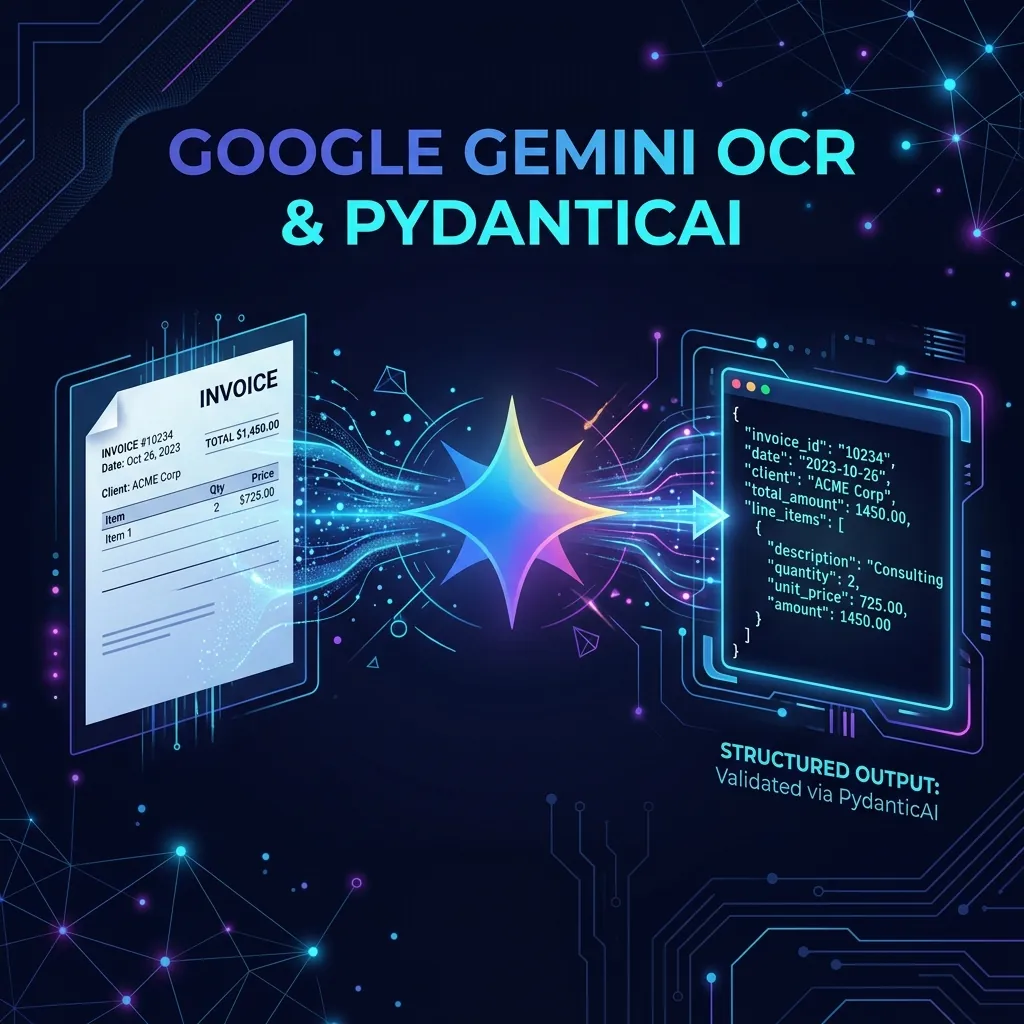
Real-world enterprise documents are messy: thermal paper receipts with faded ink, crumpled delivery notes, skewed smartphone scans, and multi-column tables with merged header cells.
Here is how to design a Zero-Failure Document Extraction Pipeline that handles handwriting and complex tables without hallucinations.
1. Schema with Self-Validating Mathematical Rules
from pydantic import BaseModel, Field, model_validator

class TableRow(BaseModel):
    item_code: str
    description: str
    quantity: float
    unit_price: float
    total: float

class FinancialDocument(BaseModel):
    document_id: str
    rows: list[TableRow]
    subtotal: float
    tax: float
    calculated_grand_total: float

    @model_validator(mode="after")
    def verify_math_consistency(self):
        computed_subtotal = sum(r.total for r in self.rows)
        # Tolerate 1-cent rounding discrepancies
        if abs(computed_subtotal - self.subtotal) > 0.05:
            raise ValueError(f"Math check failed: Rows sum {computed_subtotal} != subtotal {self.subtotal}")
        return self
2. Multimodal Extraction Engine
import os
from google import genai
from google.genai import types

client = genai.Client(api_key=os.environ["GEMINI_API_KEY"])

def extract_handwritten_table(image_bytes: bytes) -> FinancialDocument:
    prompt = (
        "Transcribe this handwritten inventory dispatch document into structured JSON. "
        "Calculate arithmetic totals verified against row values. If ink is smudged, infer the number mathematically."
    )

    response = client.models.generate_content(
        model="gemini-2.5-flash",
        contents=[types.Part.from_bytes(data=image_bytes, mime_type="image/jpeg"), prompt],
        config=types.GenerateContentConfig(
            response_mime_type="application/json",
            response_schema=FinancialDocument,
            temperature=0.0
        )
    )

    return FinancialDocument.model_validate_json(response.text)
FREE CODE TEMPLATE
Download the Complete PydanticAI Document Parser Blueprint
Get the complete, type-safe invoice and ID card parsing codebase in Python + a ready-to-run Docker environment. 100% free.