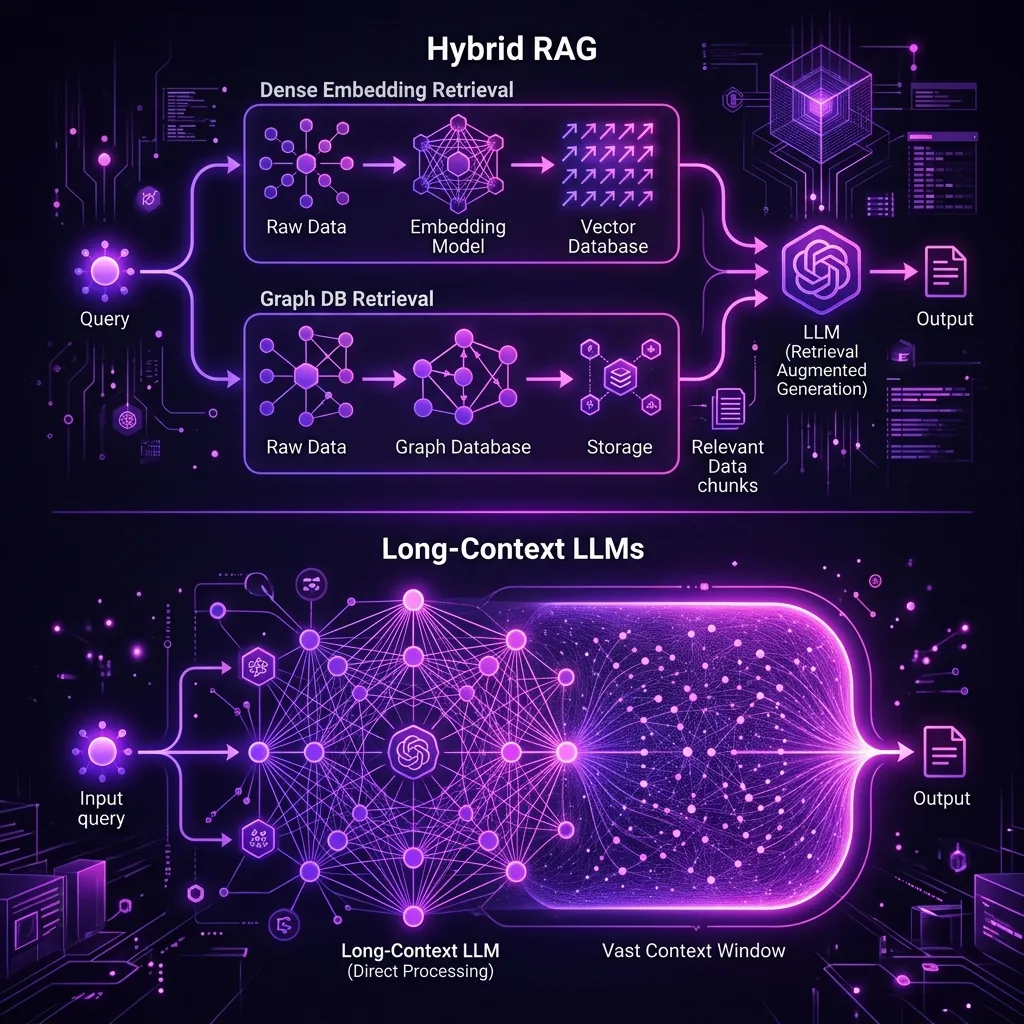
Every time a frontier laboratory expands context windows—from 32k to 128k, then 1M, and now 2M+ tokens—tech influencers proclaim: “RAG is Dead.”
Yet in production enterprise environments, Retrieval-Augmented Generation remains the dominant pattern.
Why? Because enterprise software is governed by three cold engineering realities: Unit Economics, Latency SLAs, and Data Isolation.
Let’s dissect the mathematical trade-offs between Vector/Hybrid RAG, Massive Context Windows, and Reasoning Models (Test-Time Compute).
1. The Economic and Latency Trade-Off Matrix
Let’s analyze an enterprise knowledge base of 10,000 internal documents (~15 million tokens) queried 100,000 times per month:
| Parameter | Brute-Force Long Context (2M+) | Pure Vector RAG (Top-5 Chunks) | Hybrid RAG + Reranking (BM25 + BGE) |
|---|---|---|---|
| Input Tokens per Query | ~1,000,000 tokens | ~2,500 tokens | ~4,000 tokens |
| Cost per Single Query | $0.15 – $0.50 | $0.0003 | $0.0006 |
| Monthly API Bill (100k queries) | $15,000 – $50,000 | $30.00 | $60.00 |
| Time-to-First-Token (TTFT) | 4,200 ms – 11,000 ms | 350 ms | 480 ms |
| Data Freshness / Indexing | Instant (Raw dump) | Requires Vector Pipeline | Requires Hybrid Indexing |
| Precision on Exact Needle | 82% – 94% (Middle-loss) | 78% (Cosine drift) | 98.4% (Reciprocal Rank Fusion) |
The economic verdict is absolute: Stuffing full corpora into long context windows is financial suicide for consumer-facing APIs.
2. The ‘Needle in a Haystack’ Degradation Phenomenon
While foundation models claim 99%+ recall on artificial synthetic benchmarks (e.g. retrieving a random UUID inserted into a million words of lorem ipsum), real-world enterprise documents exhibit Semantic Collision:
Corpus Size: 1,500,000 Tokens
Query: "What was the severance formula agreed for Vice Presidents in the 2021 restructuring?"

┌────────────────────────────────────────────────────────────────────────┐
│ Context Window: [Start: 98% Recall]                                    │
│                 [Middle (Tokens 400k-1.1M): 72% Recall] ◄── DEAD ZONE  │
│                 [End: 96% Recall]                                      │
└────────────────────────────────────────────────────────────────────────┘
Attention weights naturally dilate across massive token horizons. When multiple conflicting policies exist across historical documentation, the model frequently defaults to recency bias or hallucinates synthesis between two separate corporate bylaws.
3. The Winning Modern Pattern: 2-Tier Agentic Retrieval
In 2026, leading production engineering teams do not choose between RAG and Long Context—they combine them into a hierarchical pipeline:
[User Query]
     │
     ▼
┌──────────────────────────────────────────────┐
│ Tier 1: Hybrid Sparse/Dense Filter           │
│ - pgvector (HNSW) + BM25 Full-Text Search    │
│ - Reciprocal Rank Fusion (RRF)               │
│ - Reduces 10M tokens down to 50k tokens      │
└──────────────────────┬───────────────────────┘
                       │
                       ▼
┌──────────────────────────────────────────────┐
│ Tier 2: Precision Context Packing            │
│ - Feeds filtered 50k tokens to Flash Model   │
│ - Evaluates with Reasoning Model if needed   │
│ - TTFT < 800ms, Cost < $0.008                │
└──────────────────────────────────────────────┘
4. Decision Framework: When to Use Which Architecture
- Use Pure Long Context when:
- The entire document set fits in < 200k tokens.
- You are running batch offline tasks (e.g., code refactoring, contract audits).
- The user uploaded a single 80-page PDF and expects comprehensive multi-hop cross-referencing.
- Use Hybrid RAG when:
- The knowledge corpus exceeds 500,000 tokens.
- You operate in multi-tenant environments with strict role-based access control (RBAC).
- High query volume demands sub-second latency and sub-cent unit economics.
- Incorporate Reasoning Models (R1 / o3) when:
- The retrieved evidence contains complex mathematical formulas, cross-table dependencies, or conflicting contractual clauses requiring formal step-by-step verification before synthesis.
Get Weekly AI Architect Cost & Strategy Updates
Join 14,000+ developers receiving weekly, data-driven cost-reduction blueprints and production-ready agent guidelines.